Affiliate links on Android Authority may earn us a commission. Learn more.
Durability tests reveal how the iPhone Duo handles thousands of continuous folds
Oct 22, 2026 — 9:59 AM ET


- Automated stress tests by YouTuber Tim Pan (10,500 folds plus sub-zero testing) and Joanna Stern (over 32,000 folds) show that the iPhone Duo’s 3D-printed titanium hinge remains sturdy and smooth all throughout.
- However, continuous folding significantly deepens the inner display crease, both visually and to the touch.
- Other iPhone Duo quirks include single-sided NFC positioning, lack of an internal earpiece (forcing speakerphone when open), minor thermal throttling, and UI misfires when opened slowly.
Apple spent years watching Android OEMs pioneer the foldable landscape, and then made deliberate design choices to ensure its first folding iPhone wouldn’t suffer from the same teething issues as early Galaxy Fold generations. Much of that engineering effort centers on the iPhone Duo’s inner display, which uses a custom nano-texture finish to diffuse reflections and minimize the visible groove down the center. However, physics remains undefeated: a new extreme durability test shows that after 10,000 folds, that subtle crease deepens considerably.
In an exhaustive video review by Tim Pan on YouTube, the creator rigged the iPhone Duo to an automated folding machine to simulate long-term wear and tear.
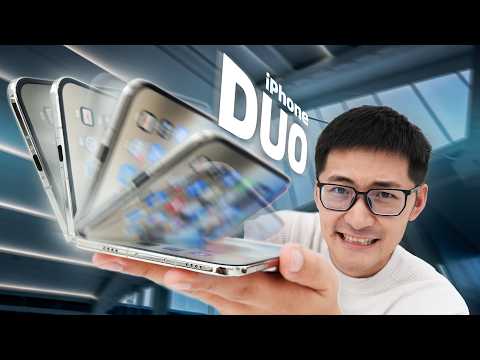
After 10,500 continuous folds at room temperature, followed by an additional 1,000 cycles inside a freezer at -4°F (-20°C), the 3D-printed titanium hinge held up remarkably well, continuing to open smoothly.
However, the display crease had visually deepened significantly compared to day one/fold one, making the center groove far more pronounced to the eye and to the touch.

Reviewer Joanna Stern on YouTube also put the iPhone Duo through a custom rig dubbed “Hingy,” racking up over 32,000 partial folds across four days. Stern noted that the hinge mechanism remained just as stiff and sturdy as on day one.
Fold stress testing has become a rite of passage for folding phones. Past independent tests, such as Tech-it’s 200,000-fold torture test on the Galaxy Z Fold 7, pushed Samsung’s hardware to extremes where the hinges began oozing internal fluid before failing completely.
Beyond the hinge and crease, Tim Pan’s deep dive uncovered several practical quirks that early adopters should keep in mind:
- One-sided NFC placement: The NFC antenna is positioned on one side of the phone, making tap-to-pay awkward when the device is unfolded.
- No internal earpiece: The inner folding display lacks an earpiece speaker. Opening the phone mid-call automatically switches the audio to speakerphone.
- Thermal throttling: While Apple implemented a novel hinge-cooling breakthrough for the Duo, keeping the phone unfolded during heavy tasks raised surface temperatures by about 3.6°F, with the A20 Pro chip side feeling substantially warmer.
- Sensor quirks: Opening or closing the hinge too slowly can cause orientation misfires, leaving UI elements flipped or temporarily blacked out.
For users eager to see whether the foldable hardware holds up in hand, you can still try your luck buying the iPhone Duo in-store. However, keep in mind that long-term durability on Apple’s first foldable involves the same display trade-offs that Android foldables have wrestled with for years.
Thank you for being part of our community. Read our Comment Policy before posting.