Affiliate links on Android Authority may earn us a commission. Learn more.


I love the Motorola Razr Ultra (2026), but I'm not sure you should buy it
8 hours ago
Motorola Razr Ultra (2026)
MSRP: $1,499.99
What we like
What we don't like
Motorola Razr Ultra (2026)


I’ve been the flip phone guy at Android Authority for several years now, but in more recent years, I’ve specifically been the Razr guy. From the minute Motorola put a bigger 3.6-inch cover display on the original Razr Plus and opened the door to my entire library of apps, I knew it was the flip for me.
Samsung has offered some impressive alternatives, but Moto has had its rival beat for several generations now. It made leaps forward, bringing its bigger cover screen to cheaper price points and spreading faster charging to the Razr series along the way. Sure, there were a few missteps here and there, like letting the Razr Plus stagnate for a few years while the Razr and Razr Ultra picked up actual updates, but I figured Motorola knew what it was doing.
Now, though, I find myself in a pickle. The Motorola Razr Ultra (2026) ($1499.99 at Amazon) has been out for about a month, and I’ve had it since almost day one. In that time, I’ve found a lot to love about the phone, but I’m worried complacency might have crept in during the design of this year’s model, and at a particularly bad time to do so due to a hefty price hike. So let’s talk about.
Motorola’s best flip phone design, refined

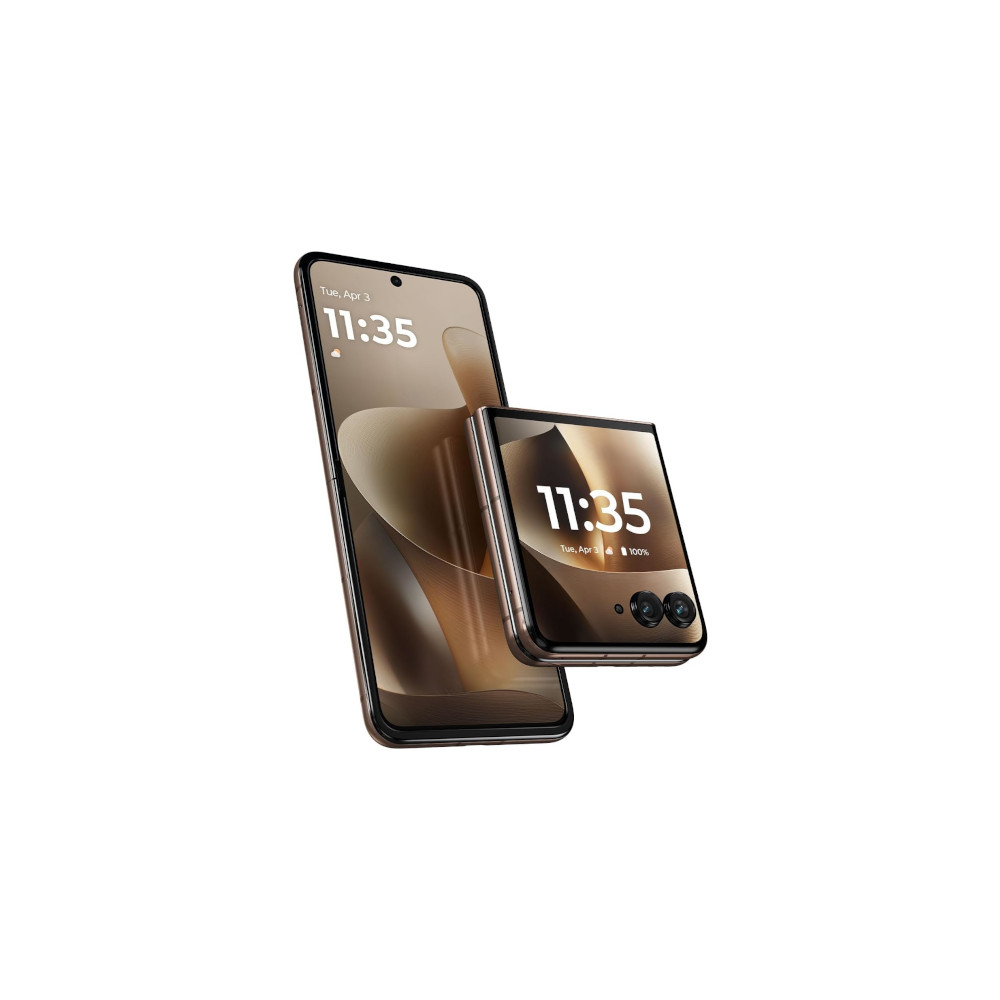
Before I get into where the Razr Ultra (2026) gives me pause, I’ll say one thing: It looks absolutely gorgeous. I loved the original Razr Ultra, with its Pantone Scarab, Cabaret, and Mountain Trail finishes (and corresponding fun materials), and I would have been upset had Motorola pivoted back to something like a boring — but sturdy — frosted glass. So, big points to Moto for keeping the fun factor alive even as it gave its stunning debutant, the Razr Fold, time in the spotlight.
I’ll admit, however, that there’s a small part of me that’s disappointed with this year’s approach to fun. Motorola halved the number of colorful finishes, offering only Pantone Cocoa and Orient Blue. And, when I unboxed my Razr Ultra (2026) and found an almost too familiar wood finish staring back at me, I wished I’d been given the other version. See, the wood finish is great, and it reminds me of the wood-paneled Moto X of old, but I already made those comparisons last year. Give me the funky fuzz of Alcantara instead, Moto.
Motorola's Pantone partnership still feels like a cheat code for good-looking phones.
Anyway, that’s a very niche complaint that only a tech reviewer could have, so let me pivot back to what Motorola got right: pretty much everything else. The Razr Ultra (2026) shares just about everything else with its predecessor, from the titanium-reinforced hinge to the brushed aluminum frame, and its dimensions (and weight) are identical. I won’t complain about any of that, because the Razr Ultra (2026) feels tight, sturdy, and reliable in hand — a far cry from the soft-hinged Razrs of a few years ago.
From the minute I picked up the Razr Ultra (2026), it felt like coming back to an old friend — there’s a familiar heft, familiar gestures, and a cover screen experience that runs circles around the Galaxy Z Flip 7 (in my book). Once I finished the setup process, I was back to gestures like twisting for the camera and chopping for the flashlight as if I’d never really left.
Unfortunately, that similarity means that one not-so-beloved feature is back, too: the AI Key. It still sits directly opposite the power button, and I still struggle to use it. My issue isn’t that I forget it’s there, but when it’s so much easier to hop into Moto AI with voice commands, I’d much rather do that and keep my hands free. If the AI Key worked like Apple’s Action Button, meaning that I could remap it to do other things, I’d be happy, but all it offers is a preset menu of Moto AI features with either a double-click or a long-press.
And, when I can also access Moto AI from one of the default apps on my Razr Ultra’s cover screen, it pushes the AI Key even further down the list. Why? Well, because I still do almost everything right from that 4-inch, 165Hz AMOLED cover screen, of course. Once again, it’s functionally pretty much the same as the cover screen on its predecessor, which means I can open just about any app in my drawer so long as I can live with the tiny window and cramped keyboard.
My eyes are maybe not what they used to be, so I’ve slowed down on trying to read long emails or do research in a tiny Chrome window, but the size is still perfect for catching up on World Cup highlights and hopping through Spotify playlists — though, sorry Motorola, Samsung still has the better Spotify widget. I also decided, just for laughs, to see how Pokémon Go fared on the tiny screen, but never quite got my fat fingers around the idea of tapping the tiny buttons. The game fully works, though, which is good for a laugh at the very least.

Alright, so despite my general feeling of sameness between the Razr Ultra (2026) and its predecessor, there’s at least one change worth noting. After swinging for the fences with a Gorilla Glass Ceramic cover screen in 2025, the new model jumps to Gorilla Glass Ceramic 3, which is designed to withstand falls onto concrete from up to two meters. I won’t be testing that, but I’m willing to trust the bright minds at Corning. I won’t be testing the IP48 rating, either — it’s good for emergencies, but still not up to the level of normal smartphones, let alone the IP68 rating of the Pixel 10 Pro Fold.
Inside the Razr Ultra’s upgraded, ultra-durable exterior is a familiar 7-inch AMOLED panel that’s a good reminder that Motorola means business. It’s still larger than the Galaxy S26 Ultra, iPhone 17 Pro Max, or Pixel 10 Pro XL, but I never mind the size. In fact, the combination of the 165Hz refresh rate and punchy Pantone-validated colors actually makes me want to open and use the main display much more than I normally do with a flip phone. But, while the display colors are nice and punchy, the stereo speakers aren’t quite there. They’re still loud, sure, but I felt like they got a little mushy when I cranked up the crowd noise on World Cup highlights.
I don't need 165Hz or 5,000 nits, but that's the price of being Ultra.
And, since I’ve spent so much time with a 7-inch AMOLED panel in front of my face, I should mention the finer features I’ve noticed — or rather, haven’t noticed. There’s still a very shallow crease running across the display, but I’ve reached the point where my eye barely clocks it, and my thumb hardly feels it. I didn’t feel like it distorted my rewatch of the USMNT’s 4-1 win over Paraguay to open the World Cup, though the very long 22:9 aspect ratio left me with black bars on both sides of the video.
One more point about the internal display: I’m starting to wonder how far Motorola is willing to go with brightness. The previous Razr Ultra (2025) topped out at 4,500 nits of peak brightness, but this new model bumps to 5,000 nits. Yes, it’s a good-looking display, but I’ve never even run into a situation where the 3,000-nit cover screen fell short, let alone having the power of a miniature sun in my pocket.
The Snapdragon 8 Elite feels familiar… too familiar

From similarity as a strength to similarity as a head-scratcher, it’s time to dive inside the Razr Ultra (2026). Just like its predecessor, Motorola’s top Razr for 2026 packs the Qualcomm Snapdragon 8 Elite chip at the heart of its aluminum-and-wood shell. It’s also backed by 16GB of RAM and 512GB of storage — though there’s notably no 1TB version available this year. That’s probably fine, though, as I’ve personally never come close to filling even a 256GB smartphone, let alone quadruple that space.
Honestly, the 16GB of RAM is also perfectly adequate — the Razr Ultra (2026) has cruised through every Moto AI query I’ve posed and mobile game I’ve revisited. I don’t even need to complain too much about the Snapdragon 8 Elite, which keeps the lights on and is still perfectly serviceable. However, it’s not unreasonable to expect a year-over-year chipset upgrade in a company’s top flip phone, especially when the Snapdragon 8 Elite Gen 5 is right there, and we’ve had a pretty serious price hike. Most premium non-folding flagships have moved to the latest silicon, including several that can be had for hundreds of dollars less than the Razr Ultra (2026), yet Motorola is content to act like the 2025 Philadelphia Phillies and run it right back with no changes. I’ll harp on this point later on in the conclusion, so for now, let’s see how last year’s chip stacks up.
As usual, that means pushing the Motorola Razr Ultra (2026) through a slate of CPU- and GPU-heavy workloads to see if we can stress it. But having spent plenty of time with the previous model, I felt like I knew the answer — I expected a big, fat no. After all, with matching RAM and an identical chipset, why should anything change?
Across both Geekbench 6 runs, I was right. Yes, the Razr Ultra (2026) scored a little higher, but it’s well within the margin of error, and could probably flip-flop each time I ran the test over again. Also, as expected, both generations of flip phones fall behind Samsung’s traditional Galaxy S26 Ultra, which uses the Snapdragon 8 Elite Gen 5 chipset — the flagship standard for 2026. It jumps ahead in both single- and multi-core performance, suggesting just a bit more raw power at the top end.
That said, the jump in PCMark performance is a little more surprising. That test is more comprehensive, so it’s nice to see the Razr Ultra (2026) both improve on its predecessor, open up a gap on the Galaxy Z Flip 7, and show that the Galaxy S26 Ultra’s power isn’t all-consuming. Thankfully, my real-world testing reflected more of that performance than the former.
Now, this is normally where I’d show you the Razr Ultra’s scores from the graphics-heavy 3DMark Wildlife stress tests. Those tests, which load the phone with 20 minutes’ worth of bright, colorful, high-frame-rate animation, are designed to see how the Razr Ultra (2026) might fare during sustained gaming. Unfortunately, the phone couldn’t finish any of the tests — not the basic Wildlife, not the intense Wildlife Extreme, and not the ray-tracing Solar Bay, either. It would get to about the middle of the gauntlet, overheat, and throw in the towel. That’s not normal.
Motorola didn't fix what wasn't broken... but somehow broke new things.
But, at the very least, it tells me something: This isn’t the pick for gamers. I didn’t expect it to be, flip phones rarely are, but I’m still surprised at just how hot the Razr Ultra (2026) felt in my hand before it quit its benchmarks. Thankfully, my luck in the real world with Pokémon Go was a little better — it ran on both the cover screen and the main display without burning a hole in my hand (or my pocket).
Honestly, aside from the stress tests, nothing else seemed to warm the Razr Ultra (2026) much, either. I took it to a sunny, noontime baseball game with my brother, snapping photos from the time we got to the bar before the game right up until we left in the eighth inning — don’t judge me, it was hot, and the Orioles were up nine to nothing. The phone warmed only a bit while I was taking photos behind home plate, which is perfectly reasonable when the camera is on for nearly 20 minutes in direct sunlight.
Once we left — and in pretty much every scenario since — the Razr Ultra was cool under pressure. I didn’t need it for any long road trips, but I did count on it to stream the audio companion to a Titanic exhibition I visited in Baltimore’s Inner Harbor while I captured some of the more interesting parts of the display. Although I wasn’t overly impressed with the exhibit itself, the Razr Ultra felt like the perfect pocket-friendly companion, and Moto AI came in handy when I had to fact-check a few of the artifacts — I wish that were a joke.

I’d also say the state of Moto AI as a whole has improved since its launch. I no longer feel like the Pay Attention tool is vastly inferior to the Pixel Recorder, and I’ve actually used it to transcribe an interview or two since receiving my Razr Ultra. Motorola’s Magic Canvas is mostly good, too, retaining both my hat and shirt in the generated image at the top of this section. Yes, there’s one pretty big mistake in the selfie — I’m not of Asian descent — but I had on large sunglasses in the original photo, so I guess Motorola had to make an educated guess.
Anyway, with all this time in the sun, I did find Motorola’s one internal change very helpful: The Razr Ultra (2026) now packs a 5,000mAh battery. It’s a nice bump from last year’s already large (for a flip phone) 4,700mAh capacity, putting it in line with the Galaxy S26 Ultra, which is one of our best phones for battery life right now. I do, however, think the bump in capacity might have come at the expense of cooling space, which could explain the poor performance in stress testing. But, before I get into my real-world battery experience, let’s look at the controlled testing.
Interestingly, the Razr Ultra (2026) isn’t a knock-out improvement over its predecessor. Despite its larger cell, it delivered better performance in only two of our five categories: camera snaps and web browsing. The metrics the rest of the way aren’t bad — they’re pretty close to or above the more powerful Galaxy S26 Ultra — but I fear my guess about less space for cooling technology has a pretty big impact.
I was, of course, still able to take my Razr Ultra (2026) for almost two days between charges, which I love. I’m always worried about the compact nature of flip phones and their battery life, but the combination of using the cover screen for most things and a few slightly cooler late Spring days has kept my Razr from cooking in my pocket.
When we flip to the battery testing, though, I’m all kinds of confused. Like its predecessor, the Razr Ultra (2026) is supposed to support wired 68W TurboPower charging with a compatible charger, but I never even came close to those speeds. I used the charging cable that Motorola included in its packaging, along with a 68W Motorola-branded charger, but still never cracked the 30W mark. Yes, I only finished charging a few minutes slower than the 2025 model, but reaching 100% took nearly 20 minutes longer than the Galaxy S26 Ultra did with its 60W Super Fast Charging.
I suppose it’s still a luxury to complain about a phone that charges in just an hour, but this feels like cause for concern. If I can’t get three pieces of Motorola hardware to work together and achieve the charging speeds they advertise, what combination am I supposed to use? When 60W charging is faster than 68W charging, are we flying too close to the sun? At least there’s 30W wireless charging, which does clear the Galaxy Z Flip 7’s 15W wireless charging in a landslide.
Same cameras, new look

With all my talk of sameness, you might look at the Razr ultra (2026) and assume its dual-camera setup is, well, more of the same. After all, it still has two 50MP sensors; they’re still sat right next to each other, and they still offer the same wide and ultrawide setup that Motorola proved to me is better than a wide-and-telephoto duo. If nothing else, that should make it the best camera on a flip phone right off the bat.
But, when you look closer, you’ll find that the 50MP primary camera now packs a LOFIC (Lateral Overflow Integration Capacitor), which isn’t actually a piece of Doc Brown’s DeLorean. Instead, it’s a sensor designed to boost dynamic range by storing excess information that would otherwise be lost in the highlights, so the phone can process it more effectively later. Basically, when you take a really bright photo, this new sensor is designed to preserve data that would otherwise turn into blown-out white areas and restore some of the color.
Otherwise, the sensor has all the good stuff — OIS, a wide ƒ/1.8 aperture, and an 85-degree field of view. It’s also Pantone-validated, which is key to the Razr Ultra (2026) developing a signature look for your photos. In my case, that just means all my shots are extremely punchy, kind of like a filter that’s applied by default. Motorola’s 50MP ultrawide sensor is a little smaller, with a maximum aperture of ƒ/2.0 and skipping OIS, but is otherwise a pretty reliable backup. So, let’s get to some samples.
Although this first row of images brings me back to the ill-fated Titanic exhibition just a bit too much, I have to say I’m pleased with the rest of the shots. The punch of the kayaks is great, lifting all the colors rather than just the reds and greens I’m used to. However, of the four, there’s really only one that will stick with me: The image of the dog on a couch. It’s possibly the cleanest, sharpest picture I’ve ever taken of a pet, either with a phone or a camera. His fur is spot-on, as are the textures on the couch, and the falloff into the background is very nice and natural.
This row features another good example of Motorola’s signature look. I took the shot of the hydrangeas on my first or second day with the phone, so my Razr Ultra was still getting used to what it thought my style was, but then I followed it up much later with the image from a baseball game to the right. Although the green hues look bright in both, the direct sunlight brings the punchiness to another level, sitting behind home plate at Camden Yards. I’ll say I like the level of detail across all three images, though I don’t know if I’d post samples zoomed in much more than the one to the right.
Unfortunately, the Razr Ultra (2026)’s ultrawide camera hasn’t found much of a spot in my regular rotation. My appreciation for the sweeping field of view comes and goes, and the extra size of the primary sensor has mostly meant I like it more. That said, the color reproduction across the two samples above is pretty similar to what I got from the primary sensor, which I appreciate.
Flipping over to the zoom breakdown, it’s pretty clear pretty quickly that the Razr Ultra (2026) doesn’t have a telephoto sensor. Although the primary sensor handles crops at 2x and 4x zoom pretty well — the colors and details are similar, if not quite exact — it drops off quickly at 10x zoom and beyond. The details drop out, the grain is more noticeable, and the color profile is just a bit flat.
If there’s a silver lining to take from this, it’s that Motorola isn’t using a load of AI upscaling to make detail out of nothing, but the smoothness of the church steeple and flatness of the cross is disappointing.
Now, the Razr Ultra (2026) actually has a third 50MP camera — the internal selfie camera — but I can’t say I’ve touched it. Yes, I opened it and looked at myself in it, but when you have a much larger sensor on the cover screen that’s actually easier to hold with the phone closed, why wouldn’t you use that instead? Well, because you might get photos like the one to the left, I guess.
Honestly, I’m not sure what happened there, because that’s exactly the type of result the LOFIC sensor is supposed to prevent. I snapped a selfie in bright sunlight, and the highlights of my hat and shirt turned bright white — not ideal. Thankfully, portrait mode fared much better as I walked down the block, and the default selfie camera got its act together in time for my brother to make a funny face. Also, I switched hats — Motorola didn’t turn my yellow bucket orange.
Of course, if you’re considering a flip phone, you might be doing so especially for its video chops. After all, you can record selfies with the 50MP primary camera as mentioned above, but you can also use the phone halfway open in camcorder mode. Either way, you get very well-stabilized footage at up to 8K resolution at 30fps (up to 60fps for 4K), and I’ve started using the Razr Ultra as my go-to for post-run Instagram stories.
You can check out full-size versions of the images above (and a bunch more) at this Google Drive link.
Motorola Razr Ultra (2026) review verdict: Should you buy it?

All told, I like the Motorola Razr Ultra (2026) — I really like it. That’s not a surprise, seeing as I liked the original Razr Ultra, and all Motorola had to do was not mess things up. On paper, it certainly didn’t. It made the battery bigger, the primary camera more capable, and the cover screen more durable, and it did all that without changing the Razr Ultra’s footprint. Win, win, win.
However, despite that general lack of change, the Razr Ultra (2026) got a price hike. Not a little one, either — this flip phone now costs $1,500 ($200 more than the 2025 model). That’s a lot of money. That’s more than the Google Pixel 10 Pro XL ($1199 at Amazon) with 512GB of storage. It’s more than the Samsung Galaxy S26 Ultra ($1299.99 at Amazon) that I’ve compared the Razr to over and over again in this review. It’s more than the Galaxy Z Flip 7 ($1099.99 at Amazon) too, which is its most realistic competition here in the US, and now typically sells for under $1,000. Oh, and all of those phones will get seven years of software updates compared to Motorola’s three Android updates and five years of security patches.
The Razr Ultra (2026) is fantastic, but the 2025 model gives you so much of the same essential experience that it's worth hunting out.
And, when you’re faced with the limitations that still plague flip phones, I’m not really sure how you justify spending even more money on this one when it packs last year’s chipset, a repackaged design that comes in fewer colorways, and TurboPower charging that doesn’t really reach its advertised peaks.
But the real problem? As I write this, you can still find the original Razr Ultra ($1299.99 at Amazon) in stock on Motorola’s website for $800. Yes, the same price as Motorola is asking for the base Razr (2026). As a self-proclaimed Razr fanboy, you should absolutely buy that phone while you still can. If money is no object, I can still recommend it wholeheartedly as a great buy, but for most folks, its predecessor offers 90% of the experience for just over half the cost, plus more color options.
Speaking of colors, if you really want a new Razr, the entry-level Razr (2026) ($799.99 at Amazon) is your best bet. It gets four Pantone-inspired colors to the Ultra’s two, and I have to admit I’m partial to Bright White, which looks like a pearl or the underside of a seashell. It’s a nice take on a simple color, and is maybe a little more interesting than the vegan leather on the other colors. Specs-wise, the base model is a little behind the Ultra, packing a 4,800mAh cell, 30W wired charging, and MediaTek’s Dimensity 7450X chipset, but, again, it’s a much more affordable way to try a flip phone.
Realistically, for the price that Motorola is asking, you could also go higher and buy a book-style foldable like the Motorola Razr Fold ($1899 at Motorola) or Galaxy Z Fold 7 ($1599.99 at Amazon), both of which will give you a lot more screen real estate and third rear cameras for comparatively not that much more money, or you should go lower and pick up one of the powerful, traditional flagships I mentioned above. They may not be as flashy, but they’ll offer the best of the best in terms of cameras and durability.
- Upgraded battery
- Eye-catching design
- Excellent cover screen
- Punchy cameras
- Solid CPU performance
- Painfully expensive
- Minimal hardware updates
- Weak software commitment
Thank you for being part of our community. Read our Comment Policy before posting.